
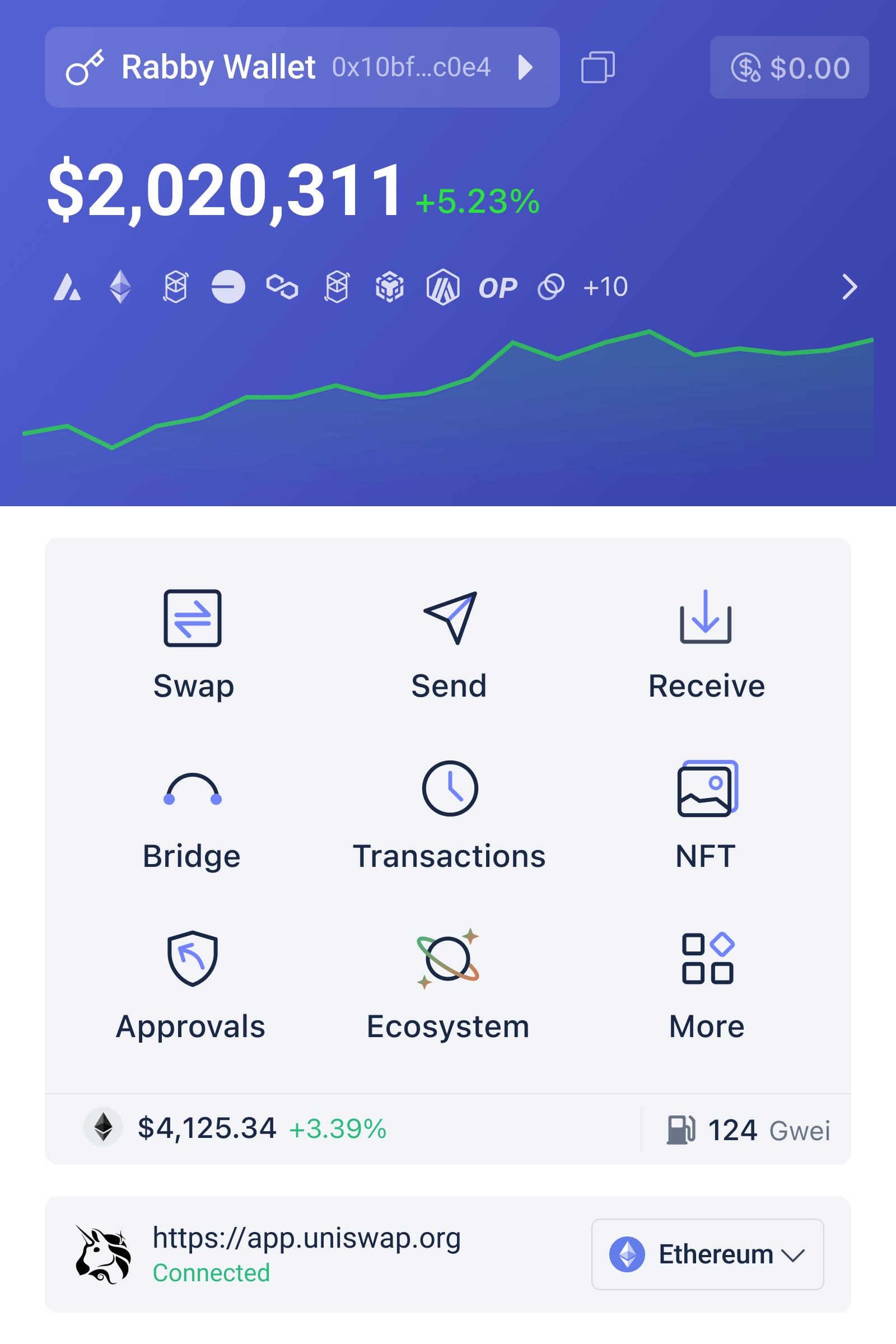
A wallet can display a warning and still leave the final decision entirely to you. That apparently simple fact corrects one of the most persistent misconceptions in DeFi: security is not a feature that a wallet can switch on, but a process of reducing uncertainty before a transaction is signed. Rabby Wallet is designed around that process. Its multi-chain interface, contract warnings, and transaction simulation are intended to show what an action is expected to do before the private key authorises it. For users in Germany and elsewhere in the German-speaking market, this matters because a convenient wallet must also make complex activity understandable, especially when assets move between several EVM networks.
Rabby is a non-custodial wallet developed by DeBank for Ethereum and other EVM-compatible networks. Non-custodial means that the private keys remain under the user’s control and are stored locally rather than being handed to the wallet provider. That arrangement removes one class of intermediary risk, but it does not remove responsibility. A compromised device, a malicious approval, a copied seed phrase, or a deceptive website can still lead to losses. The useful question is therefore not whether Rabby makes DeFi “safe”, but how its mechanisms change the quality of the user’s decision before signing.
Why transaction simulation is more than a balance check
In a conventional wallet flow, a decentralised application sends transaction data to the wallet. The user may see a contract address, a method name, a gas estimate, and perhaps a token amount. That information is often too close to the programming interface and too far from the economic effect. A transaction simulation changes the question from “What data am I signing?” to “What is this action expected to change?”
Before signing, Rabby simulates the proposed transaction and presents expected changes to token balances. In a simple swap, this can help the user compare the token leaving the wallet with the token expected in return. In a more complicated DeFi interaction, the result may expose several movements: an approval, a deposit into a protocol, receipt of a position token, or transfer of assets to another address. This is a conceptual improvement because it connects technical calldata with the user’s actual portfolio.
The mechanism has an important boundary. A simulation is an estimate produced from the current state of a blockchain and the transaction as submitted. It is not a guarantee about the future result. State can change before the transaction is mined; liquidity can move; a quote can expire; a sequencer or network can behave differently; and a contract can contain logic that is difficult to model perfectly. Simulation is therefore best understood as a pre-signing test, not an insurance policy.
This distinction is particularly important for approvals. An approval does not necessarily move tokens immediately. It grants a contract permission to spend up to a specified amount later. A user who focuses only on the immediate balance change may miss the longer-lived authority being created. Rabby’s security scanner is designed to flag risks including suspicious contracts, phishing indicators, known issues, and potentially unlimited approvals. The practical lesson is that users should inspect both the expected asset movement and the permission being granted.
Rabby installieren: convenience should not outrun verification
For readers searching for “Rabby installieren”, the safest starting point is the project’s official distribution channel rather than a sponsored search result, a reposted installer, or an unfamiliar browser extension. Rabby is primarily available as a browser extension for Chrome, Brave, and Edge, with desktop versions for Windows and macOS and mobile applications for iOS and Android. Before creating or importing a wallet, verify the publisher, the application identity, and the surrounding website address. A fake wallet can imitate branding convincingly while quietly capturing a recovery phrase.
The installation decision also involves a trade-off. A browser wallet is convenient because it connects directly to decentralised applications, but the browser is a large and attractive attack surface. Good operational practice includes using a dedicated browser profile, keeping the operating system and browser updated, and refusing unsolicited requests to reveal a seed phrase. Rabby does not need the recovery phrase to be entered into a support chat or website. If a website asks for it, the interaction is already outside the normal security model.
Users with meaningful holdings may combine Rabby with a hardware wallet such as Ledger, Trezor, or OneKey. In that arrangement, Rabby can provide the interface, warnings, and transaction interpretation while the hardware device protects the signing key. This separation is valuable, but it does not make a malicious transaction harmless. A hardware wallet can securely sign an action that the owner misunderstood. Simulation and careful review remain necessary.
Rabby’s open-source architecture and MIT licensing allow community inspection of the software, which is a meaningful transparency measure. It should not be confused with a complete audit of every dependency, server response, integration, or user device. Open source improves the possibility of scrutiny; it does not prove that every future version is free of defects.
Multi-chain design: fewer clicks, more state to understand
Rabby supports more than 140 EVM-compatible blockchains and networks, including Ethereum, Polygon, Arbitrum, Optimism, Avalanche, Base, and BNB Chain. It can automatically detect the network requested by a decentralised application and switch accordingly. This removes a common source of friction, especially for users moving between Ethereum mainnet and layer-two networks. The same convenience, however, can make network context less visible. A familiar token symbol on one chain is not automatically the same asset or liquidity environment on another.
Bridges make this issue more consequential. Rabby integrates bridge routes, including LI.FI, so users can move assets across chains from within the interface. A bridge transaction is not merely a transfer between two account views. It can involve a source-chain contract, a routing protocol, a relayer or message system, and a destination-chain settlement. The interface may simplify the path, but the underlying trust assumptions remain distributed. Users should inspect the source and destination networks, the received asset, fees, route, and any additional approvals.
The integrated swap function similarly scans decentralised exchanges such as Uniswap and 1inch to seek competitive rates and lower slippage. Aggregation can improve execution by comparing venues, but “best rate” is not the same as “best total outcome”. Gas costs, price impact, route complexity, approval requirements, and smart-contract exposure all matter. A cheaper quoted exchange can be less attractive if it depends on a more complicated route or creates an unnecessary permission.
Rabby’s Gas Account can allow users to pay network fees with stablecoins such as USDC across networks, even when they lack the native token required for gas. This solves a real usability problem: a user may hold value on a chain but be unable to perform a transaction because the fee token is missing. Yet the feature does not eliminate fees; it changes how they are funded and may introduce its own conversion, routing, or service dependencies. It should be viewed as an access mechanism, not as free execution.
A practical review framework before signing
A useful habit is to read a transaction in four layers. First, identify the network: is the dApp connected to the chain you intended to use? Second, identify the authority: is this a transfer, an approval, a permit, or a contract interaction that can spend assets later? Third, inspect the simulated result: which assets leave, which arrive, and which balances or positions change? Fourth, test the economic plausibility: does the result make sense given the price, slippage, fees, and purpose of the action?
This framework is deliberately more demanding than clicking through a warning. It is also reusable across wallets and protocols. The key mental model is that a wallet is an interpreter and signing interface, not a substitute for protocol due diligence. Rabby’s independent verification role means it does not normally rewrite the transaction for the user, and core signing functions can remain available even if Rabby’s backend services are unavailable. That independence is useful, but the wallet cannot decide whether a risky trade is economically sensible or whether a particular protocol deserves trust.
Rabby Points, earned through activities such as swaps, gas funding, or referrals, add a further behavioural consideration. Loyalty systems may make repeated interaction feel rewarding, but points should never justify an unnecessary transaction. Every additional approval, bridge, or swap creates another opportunity for fees, slippage, smart-contract risk, or user error. Incentives are not evidence of safety.
What to watch as wallet security develops
The recent positioning of Rabby in the Chrome Web Store continues to emphasise an open-source wallet for Ethereum and EVM networks, with a multi-chain experience aimed at DeFi users. The more interesting development is not simply the number of supported chains. It is the gradual movement of wallet interfaces from passive transaction signing toward contextual interpretation: showing permissions, simulating outcomes, comparing routes, and identifying network-specific hazards.
That direction could improve decision quality if the information remains clear and users learn to question it. It could also create a new failure mode: false confidence generated by a polished interface. The signal to monitor is whether warnings and simulations remain understandable when transactions become cross-chain, composable, or economically complex. In that scenario, the strongest wallet is not the one that removes every warning, but the one that makes uncertainty visible without overwhelming the user.
Frequently asked questions
Is Rabby Wallet safer than MetaMask?
It is better described as a different security and usability design rather than an automatic guarantee of greater safety. Rabby places strong emphasis on multi-chain context, transaction simulation, and risk warnings, while both wallets still depend on the user’s device, signing choices, recovery-phrase protection, and the underlying protocol. A cautious user can still be harmed by either wallet when approving a malicious or misunderstood action.
What does Rabby’s transaction simulation actually prove?
It shows the changes that the wallet expects from the proposed transaction under the simulated blockchain state. This can reveal transfers, approvals, and position changes before signing. It does not prove that the transaction will be risk-free or that conditions will remain unchanged until execution. Treat it as a powerful review aid, then confirm the network, contract, permissions, fees, and economic purpose independently.
Where should users begin when installing Rabby?
Begin with the official project distribution route and verify the publisher before installing. Users who want a direct starting point can review the rabby wallet extension information, but should still confirm the final download source and never disclose a recovery phrase. After installation, a small test transaction and a deliberate review of the simulation are preferable to immediately connecting a large account.
Rabby’s central contribution is not that it makes DeFi simple in the superficial sense of hiding complexity. Its stronger contribution is that it can place some of that complexity in front of the signature, where it can be examined. For German-speaking DeFi users managing assets across many EVM networks, that shift is practical: fewer blind approvals, clearer network context, and a better chance to stop when the expected outcome does not match the intended one. The final safeguard, however, remains a disciplined user who treats every signature as an economic decision rather than a routine click.