
Imagine you are about to execute a complex DeFi flow: bridging tokens, supplying liquidity, and granting approvals to a new automated market maker — all across Arbitrum and BNB Chain. You have accounts in hardware devices, an institutional Gnosis Safe for treasury funds, and several hot wallets for active trading. The principal risk is not a single bad smart contract but the operational friction that turns a small mistake (wrong network, blind approval, missing gas) into a permanent loss. That concrete scenario is the lens I’ll use to analyze Rabby Wallet: how to download and install it, what it changes in your operational model, and where its security guarantees stop.
Rabby is pitched to users who demand multi-chain breadth, strong pre-signature checks, and integration with hardware and institutional systems. The wallet is non-custodial, open-source, and built to prevent common operational mistakes through transaction simulation, automatic network switching, and a portfolio dashboard. Below I walk through a practical install-and-operate case, explain how Rabby’s mechanisms alter threat models and workflows, and list explicit limits and decision rules for whether Rabby should be part of your DeFi tooling.
Step-by-step: download and install, with operational cautions
For a DeFi power user operating in the US, the typical install path is: browser extension on a Chromium-based browser (Chrome, Edge, Brave), mobile app for on-the-go approvals (iOS/Android), or the desktop client for Windows/macOS. Rabby also supports hardware wallets (Ledger, Trezor, Keystone, etc.) and institutional integrations (Gnosis Safe, Fireblocks). A recommended sequence when introducing Rabby into an existing stack:
1) Install the extension or desktop client from an official channel and verify the package signature if available. 2) If you already have seed phrases or private keys, import them only after confirming a malware-free environment and, if possible, using an isolated machine for seed entry. 3) Pair your hardware device via the supported flow to keep operational keys offline where you can. 4) Enable the ‘Flip’ toggle only after testing; the feature lets you switch default injection between Rabby and MetaMask which helps in controlled migration. 5) Use the simulation and approval revocation tools immediately — revoke long-lived approvals on contracts you no longer use before engaging in complex flows.
Why these steps? Rabby reduces several attack vectors — automatic network switching prevents mismatched-chain mistakes and transaction simulation prevents blind signing — but it cannot eliminate endemic risks such as endpoint malware, phishing sites that mimic dApps, or social-engineering attacks against your seed. The wallet’s open-source MIT license helps independent audits, but that only mitigates, not removes, implementation and economic risks tied to smart contracts you interact with.
Mechanisms that matter: simulation, pre-transaction scanning, and gas top-up
Three of Rabby’s features materially change the decision calculus for an active DeFi trader: transaction simulation, pre-transaction risk scanning, and cross-chain gas top-up. Transaction simulation runs a dry-run of the transaction and displays estimated token balance changes and fees before you sign — that converts a previously opaque signing action into an explicit delta on your balances. In practice this reduces the chance of approving a contract that will drain tokens because the immediate effect becomes visible.
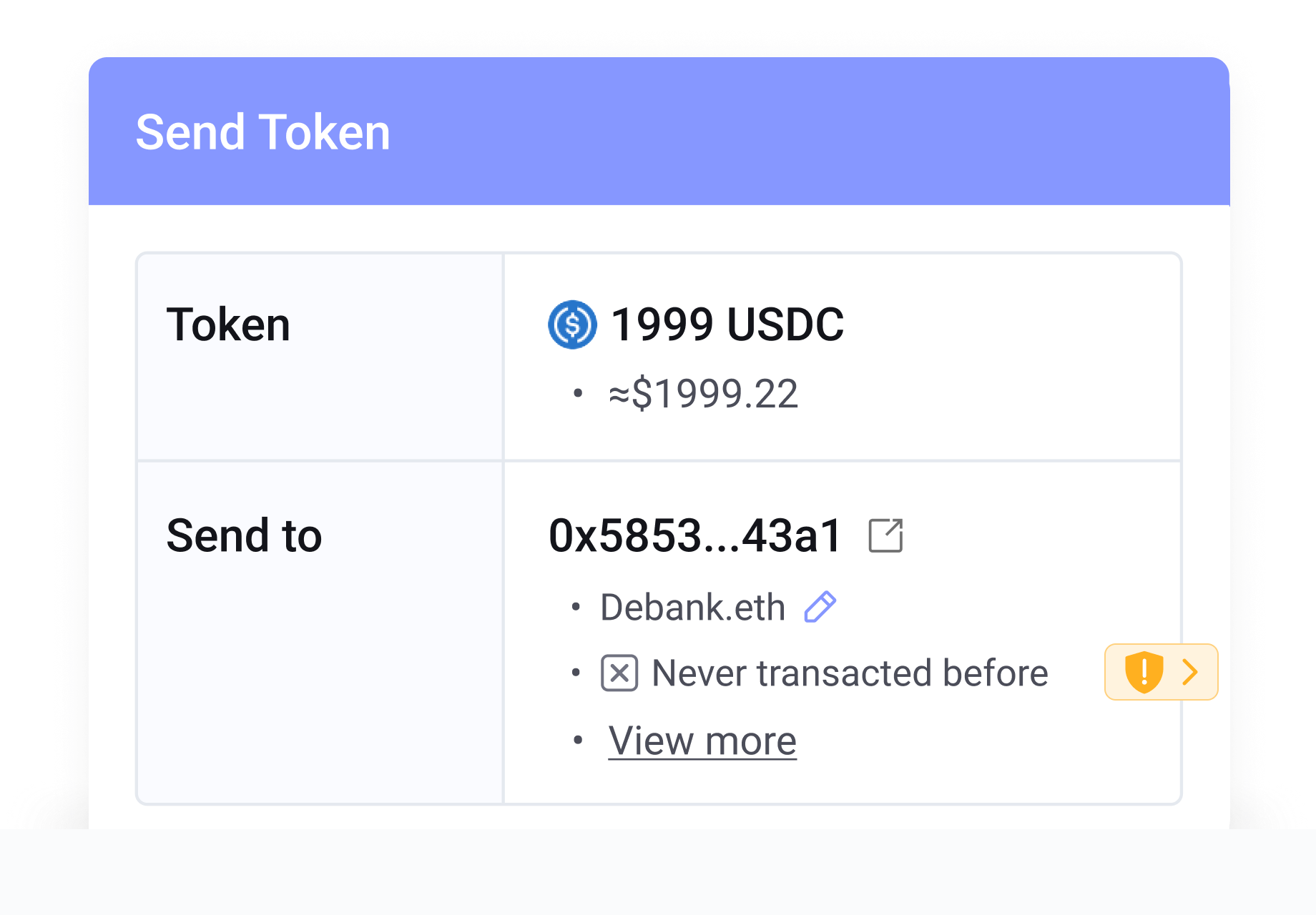
Pre-transaction risk scanning complements simulation by flagging risky patterns: interactions with contracts associated with past hacks, oddly large allowance requests, or non-existent recipient addresses. Mechanistically, this is a rules-and-signal layer feeding warnings; it does not prevent signing, so it shifts responsibility back to the user to interpret and act on a risk signal. In our case scenario — approving a new AMM router — the scan can highlight whether the router address has a suspicious history, giving you a prompt to pause and investigate.
The cross-chain gas top-up is an operational convenience with security implications. It allows you to send gas tokens (ETH, BNB) across networks so a cold-account on, say, Optimism, can execute transactions without prior balance management. That reduces risky workarounds where users borrow funds or expose seed phrases to swap for gas. But it also expands the blast radius: an attacker who compromises one hot key could be used to top up gas on other networks if approvals and flows are not gated by hardware or multisig policies.
Where Rabby materially reduces risk — and where it does not
Rabby reduces several human-driven errors: wrong-network signing, blind-signing, and stale approvals. The built-in approval revocation tool lets you list and cancel active approvals, which is a concrete way to shrink exposure to future contract exploits. Multi-sig and enterprise integrations mean high-value assets can still live under stricter institutional controls while the team uses Rabby for fast execution.
However, Rabby has boundaries you must respect. It does not provide a fiat on-ramp — you still need external services to buy crypto — and it has no native staking inside the wallet, so on-chain earning strategies require separate flows. The 2022 Rabby Swap incident (an exploited smart contract with roughly $190,000 in losses) is a reminder: application-layer contracts can fail even when the wallet functions correctly. Rabby’s security engine can flag contracts with known bad histories, but brand-new or intentionally obfuscated attacks can still slip past detection. Open-source status and audits lower systemic risk but do not remove human or economic incentives that produce novel exploits.
Trade-offs for power users: speed versus centralized convenience
Compare three typical set-ups: (A) pure hot wallet with in-wallet swaps; (B) Rabby + hardware wallets + multisig; (C) custodial exchange account. Rabby is a middle path: it preserves non-custodial control (unlike custodial exchanges) while adding operational safety over basic hot-wallet use. The trade-offs are clear:
– Security: Rabby plus hardware and multisig increases resilience, but relies on correct operational discipline. – Convenience: automatic network switching and simulation speed up flows compared with manual chain selection, but the lack of fiat on-ramp means extra friction for newcomers. – Control: non-custodial ownership is preserved; however, the user bears the full responsibility for recovery and key management.
A useful heuristic: use Rabby for active DeFi operations when you need quick, multi-chain interactions and pair it with hardware devices for any high-value or systemic transactions. Reserve custodial services for fiat rails or short-term market trades where execution speed and regulated custody matter more than cross-chain composability.
Practical checklist before you sign anything
When you reach a signing prompt in Rabby during a complex flow, run this quick checklist: 1) Verify simulation outputs — do the balance deltas match your intended trade? 2) Check the pre-transaction warning box for any flagged risks. 3) Confirm the network auto-switched to the expected chain. 4) Ensure any spending approvals are minimal and time-limited when possible. 5) If the transaction involves large sums, require a hardware signature or a multisig threshold. These five steps convert Rabby’s UX features into operational habit.
For teams: codify the above into an approvals playbook and use Rabby’s compatibility with Gnosis Safe or other enterprise tools to enforce multi-party confirmations for significant transfers.
What to watch next (signals and limits)
Signals that would change the evaluation of Rabby include: new classes of automatic detection (e.g., heuristics that detect rug-pull patterns before exploits occur), native fiat on-ramp integrations, or extended on-chain governance features. Conversely, fresh exploit patterns that bypass simulation (for example, contracts that obfuscate token flows during a dry-run) would widen the residual risk despite Rabby’s protections.
Monitor three measurable indicators: the wallet’s security audit cadence and findings, evidence of false negatives in the risk scanning layer, and the frequency with which users need to cross-chain gas top-ups (since excessive need indicates UX or infrastructure gaps that raise operational risk).
For a step-by-step download or install guide and official links to Rabby resources, start at this consolidated resource: https://sites.google.com/cryptowalletextensionus.com/rabby-wallet/. Use the official channels listed there and confirm checksums where provided.
FAQ
Is Rabby safer than MetaMask for DeFi power users?
“Safer” depends on which risks you prioritize. Rabby reduces operational errors by simulating transactions and auto-switching networks, which cuts down common user mistakes. However, both are non-custodial and subject to the same fundamental hazards: compromised endpoints, phishing, and vulnerable smart contracts. For high-value operations, pairing Rabby with hardware wallets and multisig remains essential.
Can Rabby prevent every possible exploit?
No. Rabby’s pre-transaction scanning and simulation lower the probability of certain classes of mistakes and known contract risks, but novel or well-obfuscated exploits can bypass detection. The wallet is a risk-mitigation layer, not a perfect safety net. Operational controls (hardware keys, multisig, approval hygiene) remain necessary.
Does Rabby support hardware wallets and institutional custody?
Yes. Rabby integrates with Ledger, Trezor, Keystone and other hardware devices and supports institutional tools like Gnosis Safe and Fireblocks, allowing you to blend fast personal UX with institutional-grade custody policies.
What are the immediate limitations I should accept before adopting Rabby?
Currently, Rabby lacks a built-in fiat on-ramp and does not offer native staking inside the wallet. Also, no wallet can fully eliminate smart contract risk. Expect to use external services for fiat conversions and separate staking interfaces where needed.
Decision-useful takeaway: Rabby is most valuable where operational mistakes are the dominant risk — active multi-chain traders, builders, and teams who need automatic network switching and explicit simulation. It is not a substitute for good custody practice; instead, treat it as a toolkit that can significantly lower human error while leaving smart-contract and endpoint risks to be managed by proven institutional controls and sound operational hygiene.